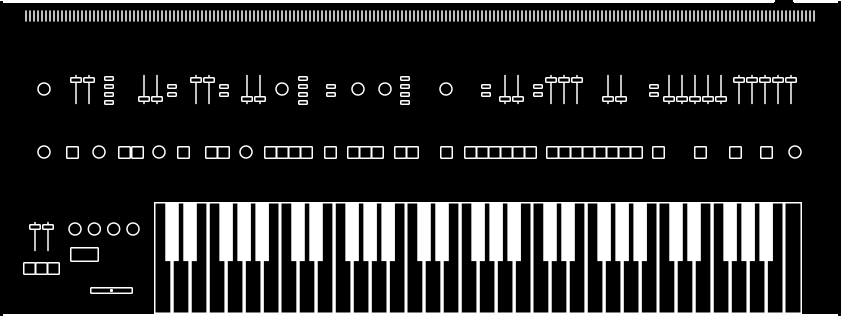
Roland Jupiter-6 Tauntek Upgrade MIDI CCs & NRPNs

MIDI implementation details for the Roland Jupiter-6 Tauntek Upgrade


Contributions welcome! You can email us your edited CSV if you don't want to use GitHub.

💾 Want to manage and save your Jupiter-6 patches? Check out Deep Edit, an in-browser editor and librarian for the Tauntek Jupiter-6.

Performance

Parameter CC Range Usage Description Orientation
Mod Wheel 1 [0–127]
0~127: Mod wheel value
Modulation wheel value. Destination is user-assignable via Tauntek settings.
Note: Destination set by Tauntek 'Mod CC Assign' bits (panel setting). Destinations listed on cheat sheet include VCO Mod - LFO1 Amt; VCF Cut - LFO1 Amt; VCA Mod - LFO1 Amt; LFO1 Rate; XMOD Amt; Pulse Width; VCF Cutoff; VCF Resonance.
0-based
Hold 30 [0–127]
0-63: Off; 64-127: On
Holds notes (panel HOLD).
0-based
Glissando 29 [0–127]
0-63: Off; 64-127: On
Enables glissando.
0-based
Bender 28 [0–127]
0-63: Off; 64-127: On
Enables bender.
Note: Cheat sheet lists as on/off; exact behaviour (range/source) not specified.
0-based
Portamento Switch 65 [0–127]
0-63: Off; 64-127: On
Enables portamento.
0-based
Sustain Pedal 64 [0–127]
0-63: Off; 64-127: On
Sustain pedal (damper) on/off.
0-based
Volume 7 [0–127]
0~127: Volume amount
Main output level.
0-based
Split Balance (CC08) 8 [0–127]
0~127: Split balance amount
Upper/lower split balance (alternate CC mapping).
Note: Cheat sheet also lists Split Balance on CC80 with explicit 0/64/127 meaning; CC08 entry in cheat sheet does not specify mapping.
0-based
Split Balance (CC80) 80 [0–127]
0~127: Split balance amount
Upper/lower split balance.
Note: Cheat sheet: 0=Lower, 64=Equal, 127=Upper.
Centered
Master Tune 79 [0–127]
0~127: Master tune amount
Master tuning (global).
Note: Cheat sheet does not describe the value mapping (e.g., centre/offset).
0-based
Key Assign Mode 77 [0–127]
0-15: Poly 1; 16-31: Poly 2; 32-47: Unison; 48-63: Solo; 64-127: Solo Unison
Key assign mode selection.
0-based
Unison Detune 63 [0–127]
0~127: Detune amount
Detune amount for unison.
0-based
Glide Time (CC05) 5 [0–127]
0~127: Glide time amount
Portamento/glide time.
Note: Cheat sheet lists CC05 as Glide Time but provides no value mapping details.
0-based
Glide Time (CC62) 62 [0–127]
0~127: Glide time amount
Portamento/glide time (alternate mapping).
Note: Cheat sheet notes: 0 = fast. Remaining mapping not described.
0-based

Oscillators

Parameter CC Range Usage Description Orientation
VCO1 Triangle 20 [0–127]
0-63: Off; 64-127: On
Enables/disables Triangle waveform.
0-based
VCO1 Saw 21 [0–127]
0-63: Off; 64-127: On
Enables/disables Saw waveform.
0-based
VCO1 Pulse 22 [0–127]
0-63: Off; 64-127: On
Enables/disables Pulse waveform.
0-based
VCO1 Square 23 [0–127]
0-63: Off; 64-127: On
Enables/disables Square waveform.
0-based
VCO2 Triangle 24 [0–127]
0-63: Off; 64-127: On
Enables/disables Triangle waveform.
0-based
VCO2 Saw 25 [0–127]
0-63: Off; 64-127: On
Enables/disables Saw waveform.
0-based
VCO2 Pulse 26 [0–127]
0-63: Off; 64-127: On
Enables/disables Pulse waveform.
0-based
VCO2 Noise 27 [0–127]
0-63: Off; 64-127: On
Enables/disables Noise waveform.
0-based
VCO 1 Range 40 [0–127]
0~127: Range value
VCO1 octave range selector.
Note: Cheat sheet lists parameter but does not provide discrete value map.
0-based
VCO 2 Range 41 [0–127]
0~127: Range value
VCO2 octave range selector.
Note: Cheat sheet lists parameter but does not provide discrete value map.
0-based
VCO 2 Fine 42 [0–127]
0~127: Fine tune amount
VCO2 fine tuning.
0-based
VCO Mixer 43 [0–127]
0~127: VCO mix amount
Mix between VCO1 and VCO2.
Note: Cheat sheet specifies: 0 = full VCO1. Remaining mapping not described.
0-based
Pulse Width 36 [0–127]
0~127: Pulse width amount
Pulse width (PW).
0-based
PWM Amount 37 [0–127]
0~127: PWM amount
PWM modulation amount.
0-based
PWM Mod Source 67 [0–127]
0-63: ENV1; 64-127: LFO1
PWM modulation source select.
0-based
VCO Mod Amount 34 [0–127]
0~127: VCO mod amount
VCO modulation amount (mod wheel destination option).
0-based
VCO Mod Source 68 [0–127]
0-31: None; 32-63: VCO1; 64-95: VCO2; 96-127: VCO1+2
VCO modulation source selection.
0-based
VCO Mod By ENV1 35 [0–127]
0~127: Amount
VCO modulation by ENV1 amount.
0-based
XMOD Manual 38 [0–127]
0~127: XMOD amount
Cross-mod manual amount.
0-based
XMOD By ENV1 39 [0–127]
0~127: Amount
Cross-mod by ENV1 amount.
0-based
Osc Sync Mode 72 [0–127]
0-31: None; 32-63: VCO2 syncs to VCO1; 64-95: VCO1 syncs to VCO2; 96-127: Both sync
Oscillator sync mode.
Note: Cheat sheet formatting is slightly unclear; this is the most consistent interpretation of the listed ranges.
0-based
VCO 1 Wave Bitmask 69 [0–127]
0~127: Wave enable bitmask
Waveform enable bitmask for VCO1.
Note: Cheat sheet: Bit 3=Triangle; Bit 4=Saw; Bit 5=Pulse; Bit 6=Square. Value is a bitfield (multiple waves can be enabled).
0-based
VCO 2 Wave Bitmask 70 [0–127]
0~127: Wave enable bitmask
Waveform enable bitmask for VCO2.
Note: Cheat sheet: Bit 3=Triangle; Bit 4=Saw; Bit 5=Pulse; Bit 6=Noise. Value is a bitfield (multiple waves can be enabled).
0-based

LFO

Parameter CC Range Usage Description Orientation
LFO1 Rate 32 [0–127]
0~127: Rate amount
LFO1 rate.
0-based
LFO1 Delay 33 [0–127]
0~127: Delay amount
LFO1 delay.
0-based
LFO1 Shape 66 [0–127]
0-31: Triangle; 32-63: Saw; 64-95: Square; 96-127: Random
LFO1 waveform shape selection.
0-based

Filter

Parameter CC Range Usage Description Orientation
VCF Frequency 44 [0–127]
0~127: Cutoff amount
Filter cutoff frequency.
0-based
VCF Resonance 45 [0–127]
0~127: Resonance amount
Filter resonance.
0-based
VCF Mod By ENV 46 [0–127]
0~127: Amount
Filter envelope modulation amount.
0-based
VCF Mod By LFO1 47 [0–127]
0~127: Amount
Filter LFO1 modulation amount.
0-based
VCF Keyboard Tracking 48 [0–127]
0~127: Tracking amount
Filter keyboard tracking amount.
0-based
Filter Mode 71 [0–127]
0-31: LPF; 32-63: HPF; 64-127: BPF
Filter mode selection (LP/HP/BP).
0-based
VCF Envelope Select 73 [0–127]
0-63: ENV1; 64-127: ENV2
Select which envelope modulates VCF.
0-based
VCF ENV1 Polarity 74 [0–127]
0-63: Positive; 64-127: Negative
ENV1 polarity for VCF modulation.
0-based

Amplifier

Parameter CC Range Usage Description Orientation
VCA By ENV2 Amount 49 [0–127]
0~127: Amount
VCA envelope 2 amount.
0-based
VCA Mod By LFO1 50 [0–127]
0~127: Amount
VCA LFO1 modulation amount.
0-based

Envelope 1

Parameter CC Range Usage Description Orientation
Attack 51 [0–127]
0~127: Attack amount
Envelope 1 attack time.
0-based
Decay 52 [0–127]
0~127: Decay amount
Envelope 1 decay time.
0-based
Sustain 53 [0–127]
0~127: Sustain amount
Envelope 1 sustain level.
0-based
Release 54 [0–127]
0~127: Release amount
Envelope 1 release time.
0-based
Key Follow 55 [0–127]
0~127: Key follow amount
Envelope 1 key follow amount.
Note: Cheat sheet label appears as 'KFOLLOW'.
0-based

Envelope 2

Parameter CC Range Usage Description Orientation
Attack 56 [0–127]
0~127: Attack amount
Envelope 2 attack time.
0-based
Decay 57 [0–127]
0~127: Decay amount
Envelope 2 decay time.
0-based
Sustain 58 [0–127]
0~127: Sustain amount
Envelope 2 sustain level.
0-based
Release 59 [0–127]
0~127: Release amount
Envelope 2 release time.
0-based
Key Follow 60 [0–127]
0~127: Key follow amount
Envelope 2 key follow amount.
Note: Cheat sheet label appears as 'FOLLOW'.
0-based

Arpeggiator

Parameter CC Range Usage Description Orientation
Arp Rate 61 [0–127]
0~127: Arp rate amount
Arpeggiator rate (when MIDI clock selected).
Note: Cheat sheet: 'WHEN MIDI CLK SELECTED'.
0-based
Arp Mode 84 [0–127]
0-63: Off; 64-79: Up; 80-95: Down; 96-111: Up/Down; 112-127: Random
Arpeggiator mode.
0-based
Arp Range 85 [0–127]
0-31: 1 Oct; 32-63: 2 Oct; 64-95: 3 Oct; 96-127: 4 Oct
Arpeggiator range (octaves).
0-based

The portions of this library that refer to specific devices may be owned by the devices' respective manufacturers. Everything else is licensed under the Creative Commons Attribution Share Alike 4.0 International license.